In Malay, the word rintik is used to describe the way rain drops fall. It is the same word that describes the collection of moisture to form morning dew – the gentle accumulation of rotundness. French has a word dégoutter which not only describes the motion of a drop of water but also the way cheese stretches when you eat a slice of pizza.
This excerpt is from an essay I wrote when applying to college – capturing a long fascination that I have had with the process of translation. When two languages brush up against each other there is often much to be said about what is lost in the slippage between them. Babel by R. F. Kuang builds an entire world around this phenomenon, where magical silver bars draw their power from what is lost in the slippages of these translations.
And we think most often about this loss when translation resists us. We feel it when one language gives us a word that cannot be reproduced in another without a paragraph. When the shape of such a word simply does not adhere to the vocabulary waiting for it on the other side. It is at this point that we are at our most thoughtful about this phenomenon, where we are forced to pause and reflect on the histories of the words we attempt to invoke.
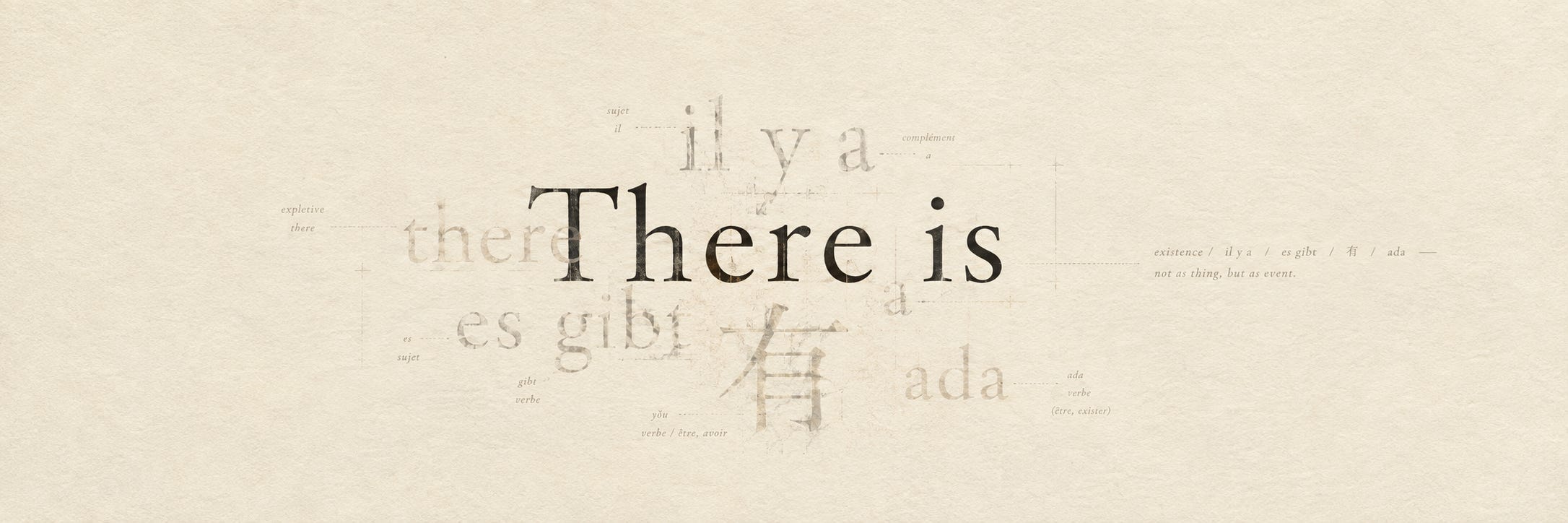
But what of the words that simply pass through this barrier unobtrusively, that simply slide between languages without any trouble? Consider perhaps one of the simplest, most fundamental phrases we have – “there is”. It is almost laughably easy to translate this phrase into other languages.
There is a problem, il y a un problème, es gibt ein Problem, ada masalah, hay un problema, 有问题.
These are all trivial translations. Unlike with the problematic rintik, “there is” needs no second thought. It can be almost reflexively swapped in with its counterparts in other languages with the proposition existing perfectly intact – there seems to be a problem. In the world of Babel it is likely that “there is” would have no power at all, it crosses between languages too cleanly.
But in this, we lose some of the nuances each language uses to articulate this idea. The French il y a retains the locative-ness of the English, but also invokes possession – “it there has”. Malay’s ada similarly spans across existence and possession. The German es gibt however, translates literally to “it gives”. In each case, while the proposition remains, part of its architecture is discarded.
What is significant about this loss? Just as we don’t believe the French cannot differentiate between having a slice of pizza and needing an umbrella, we cannot similarly claim that German makes it easy to think of existence as a gift while English might make that connection harder to locate. The difference is more banal – some associations simply exist closer in some languages than in others.
In German, the formulation of “it gives” has provided the material for a rich tradition of thought. Husserl developed Gegebenheit, or givenness, to describe what is given to our intuition before we analyze or judge it. Heidegger, perhaps, takes this the farthest with es gibt Sein – “it gives Being”. What originates as a mundane expression of existence can now become interrogated, we can focus not just on Being, but how it is given. These thinkers had a connection between existence and giving made available to them by language, and chose to press it further.
The difference between these languages is not in what they can express – if you stitch enough words together, you can convey enough meaning. The difference is instead in the price we pay to make that meaning explicit. English lets us stitch enough words to form the phrase “existence is a gift”, but German makes this turn readily available in an ordinary phrase.
The possibilities that these enable is what successful translation struggles to carry. We can render es gibt Sein as “there is Being” in English, but in doing so lose the linguistic proximity that made Heidegger’s move possible. “It gives Being” is instead awkward enough that it forces us to notice this history.
The gaps between languages are usually the ones we pay most attention to. But perhaps we should be just as suspicious when we can cross them too easily. Translation might bring us to the same destination, while changing which turns were obvious along the way.